Type – Comedy, Reflective
If you liked – Three Men in a Boat, The Play That Goes Wrong
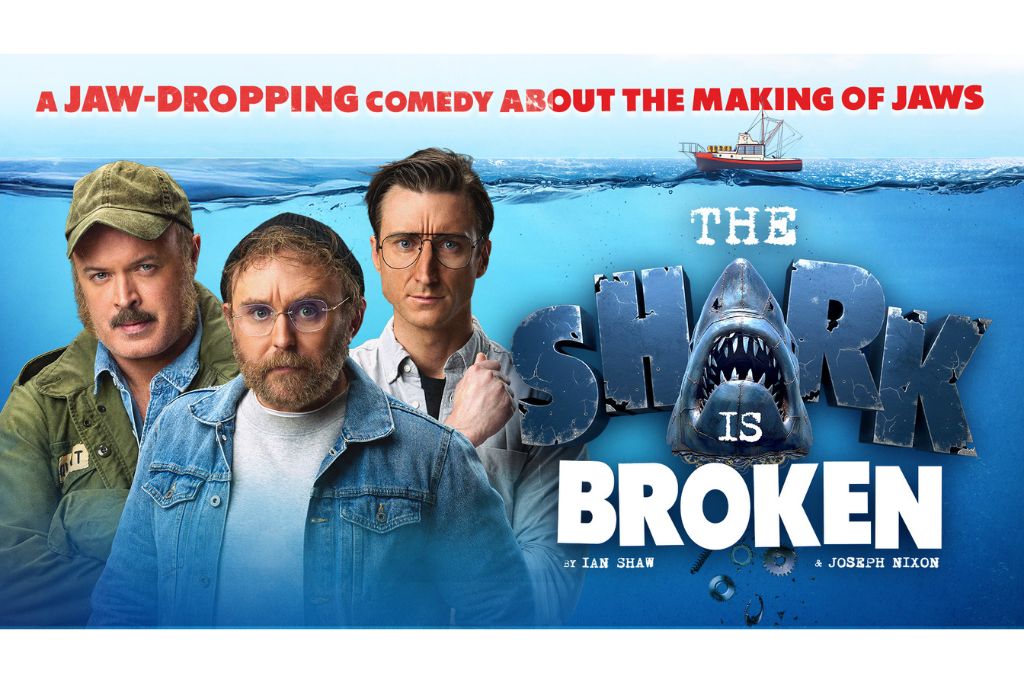
The Shark is Broken: Three men, one boat, and a shark that won’t clock on!
The Australian production of Ian Shaw and Joseph Nixon’s play The Shark is Broken, a comedic behind-the-scenes exploration of the filming of the Steven Spielberg classic film Jaws, is directed by Luke Joslin of Cluedo fame, now playing at Melbourne’s Athenaeum Theatre.
The play begins with the famous two-note motif from John Williams’ score for Jaws and the crowd acknowledged it immediately. We start with a view of the actors on the Orca as they prepare to shoot a scene. They are on the edge of their seats, and seem to be peering over at a distance into the ocean. Have they spotted some movement afar? Maybe a ripple in the waters? There is silence, and you wonder how the cinematic feeling of thrill and dread will manifest in the Athenaeum halls.
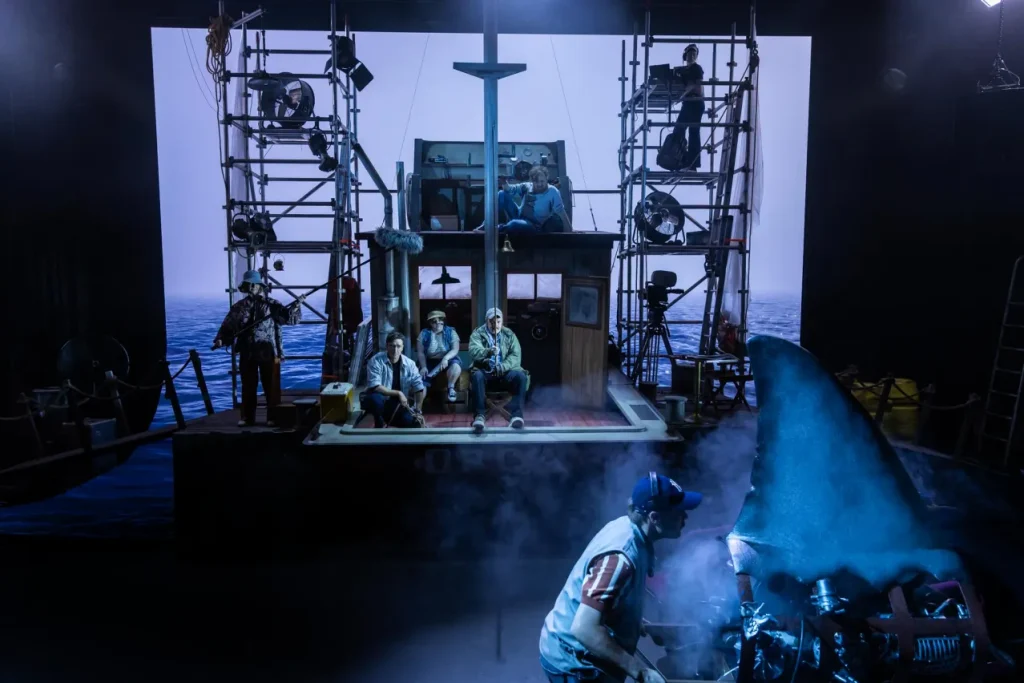
Suddenly, the “shark” enters from stage-right, “walks” across the stage with all the resignation of a man clocking on and none of the menace the job requires, and announces with a groan that the shark is broken again, at which there is a collective sigh among the entire crew, someone yells “Cut!”, and “Bruce” (nickname for the shark) sheepishly walks off as the actors pause for yet another break.
Spielberg was all of twenty-seven years old during the filming of Jaws, and was about to find out that the biggest battle for his movie would be fought not in the waters, but on the set. Jaws ended up being one of the few movies of its time to exceed its intended principal photography timeline by over a hundred days—causing Spielberg to fear it might end his career—and The Shark is Broken explores not so much the reasons that caused the delays, but rather the camaraderie between the actors as they were stuck with each other for so long, spending a large amount of time filming in the open waters and sandy beaches of Martha’s Vineyard in Massachusetts. Eventually, tensions erupted as the crew battled frustrations, seasickness, actors nearly getting locked in cages, and an actual boat sinking.
Robert Shaw – the father of playwright Ian Shaw – is said to have initially disliked everything from the book to the script and even the title of the film, and reportedly only signed on to pay off his IRS dues. Richard Dreyfuss at this point was coming off filming The Apprenticeship of Duddy Kravitz, a performance he was reportedly unsure of. Roy Scheider came to distrust special effects and constantly second-guessed the impact of such a film on his career.
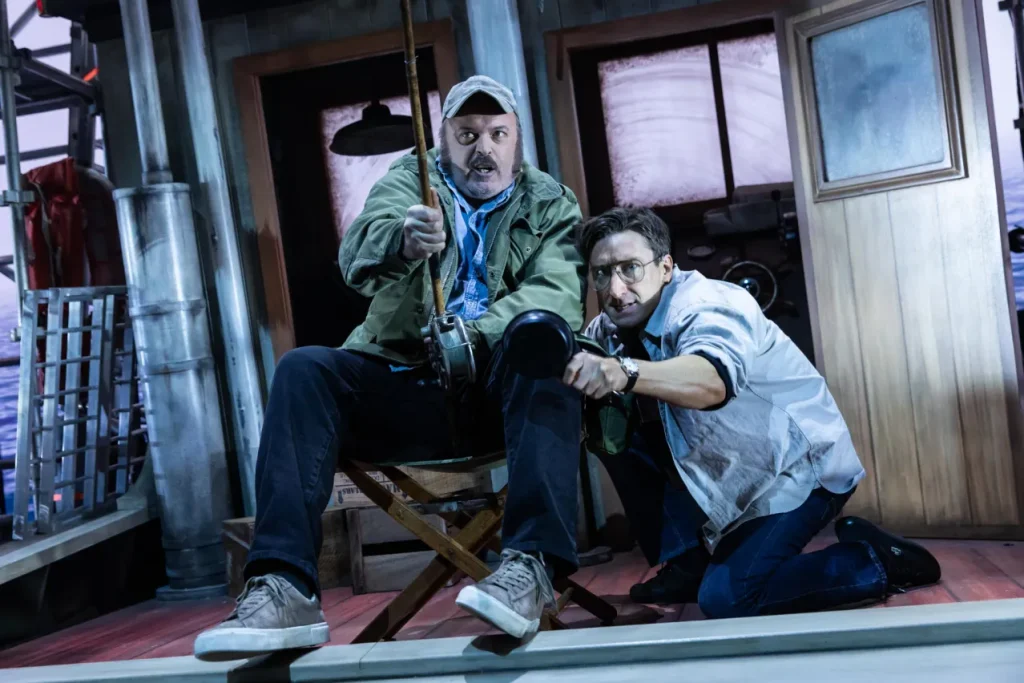
Robin Goldsworthy’s Dreyfuss is at times over-dramatic and physically comedic, and at others vulnerable and insecure about his credentials as an actor. Goldsworthy’s explosive interactions with Anthony Gooley who plays Robert Shaw are a nod to the well-documented feud between the original actors during the movie’s production. As the more established and veteran actor of the three, Robert Shaw has by now a certain world-weariness, an affinity for alcohol, and a temper that isn’t much helped by the continual production delays. He is looking for an excuse to be combative and competitive, and in Dreyfuss, he finds an easy target. Tom Stokes plays Roy Scheider as the calm centre of the boat, sunbathing on the upper deck above the brawl and stepping in only when it threatens the shoot.
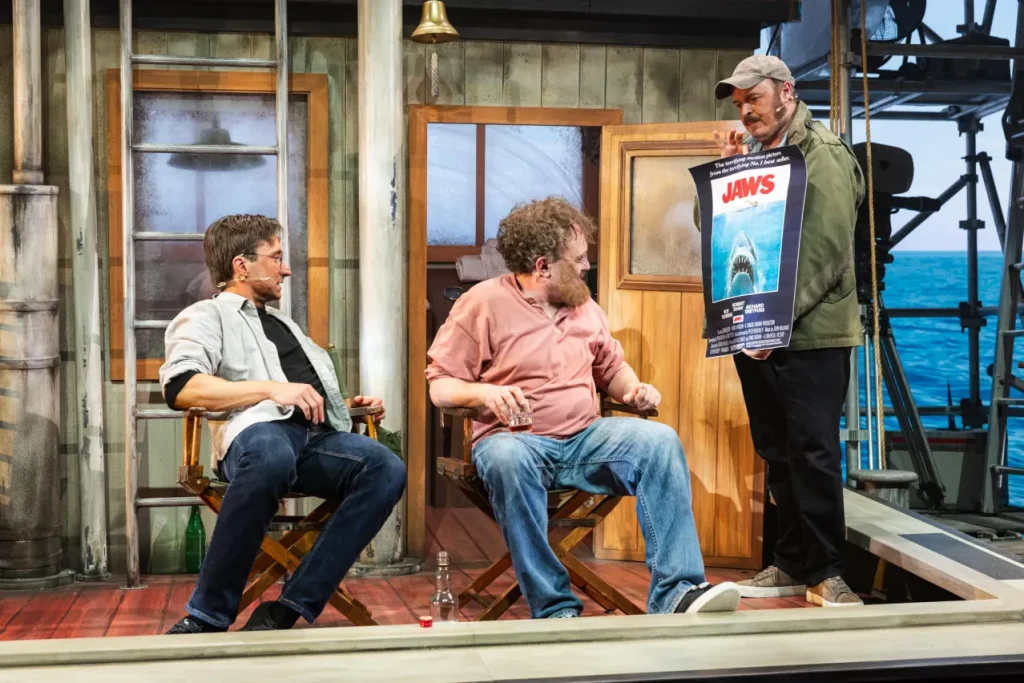
The set by James Browne incorporates several spaces within spaces. Alongside a main ship deck where most of the action takes place, there is also a cabin from where Robert Shaw delivers his famous USS Indianapolis monologue, and an upper deck area where Scheider sunbathes. Video designer Cameron Smith’s water projection heaves behind them, lighting designer Jasmine Rizk’s storm flashes across the deck, and in the cabin a swinging lamp sweeps light and dark over the men’s faces, shifting with their moods as the play darkens. Unlike the men in the movie, you don’t feel like you’re going to need a bigger boat because Joslin has his actors jump up, crawl into, dance across, and use every inch of the set with ease.
Movies are a place to happily suspend disbelief; you almost forget for those couple of hours that the actors and technicians behind the movie all have real lives, worries, insecurities, and existential crises of their own. The Shark is Broken invites us into the personal nightmares of the cast of Jaws, and navigates their ramblings about everything from how each sport – except one – is really a sperm race, to what possible meaning the story of Jaws could convey. Joslin handles the play’s tonal shift from animated banter to harder confessional material with the same finesse as the Orca as it cuts through water, never letting the pace feel slow in this ninety minute play with no interval.
Is The Shark is Broken worth seeing in Melbourne?
From the anticlimactic opening scene to the ludicrous pose struck by Robert Shaw while playing Shove Ha’penny, and from emotional breakdowns fueled by alcohol to Bruce discovering newer ways to keep mechanically breaking down, this performance is memorable as much for its quieter moments as its jokes.
Jerome K. Jerome showed us in 1889 that three men on a boat is an occasion for endless banter, friendship, and entertainment. Sure, the jokes in The Shark is Broken land better if you know the film, but the experience doesn’t insist on it, and overall it is well worth your time.
Tickets and Practical Info for The Shark is Broken in Sydney 🎟️
Venue: Athenaeum Theatre
Dates: 15 Oct – 8 Nov 2026
90 min, no interval
Note: This production includes intermittent strong language, references to drug and alcohol use, depictions of alcohol abuse, and tobacco/cigarette smoking on stage. This production is recommended for ages 12+.
Ticket link: https://sharkisbroken.com.au/#tickets