
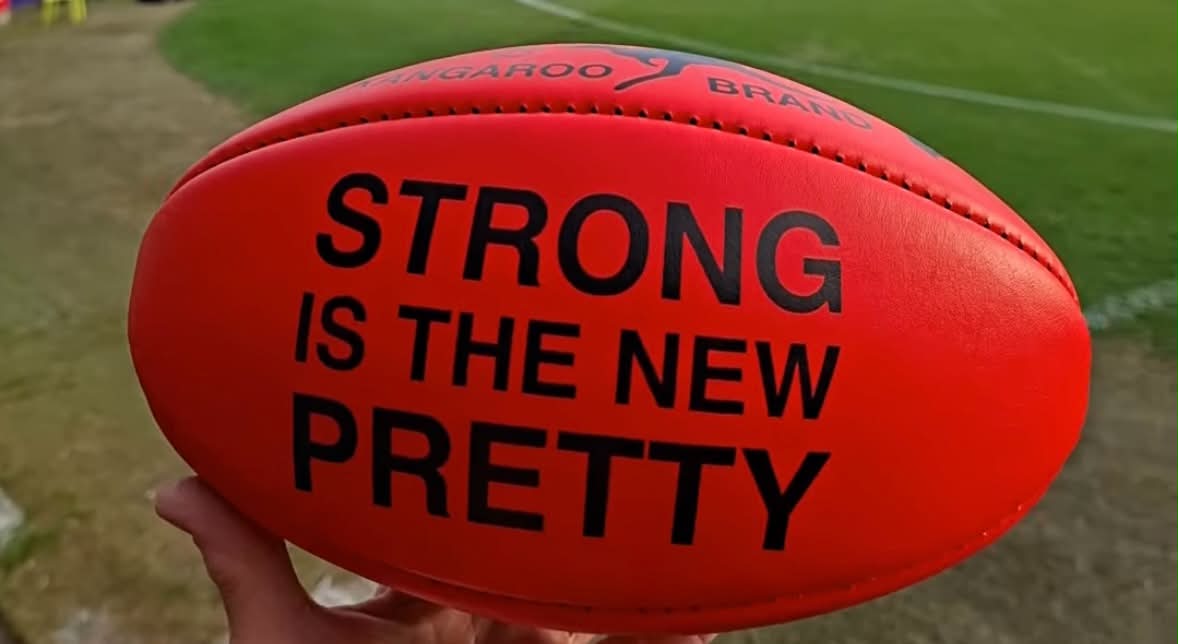
Capturing the spirit, ingenuity, audacity and tenacity of the women who started the AFLW on stage in Suzie Miller’s latest work Strong is the New Pretty
Strong Is the New Pretty is Suzie Miller’s latest work to hit Australian stages. Inspired by her experience growing up in Melbourne’s AFL culture, the work follows the untold story of the determined women whose grit, passion, and fancy footwork took the Australia’s Women’s AFL league (AFLW) from a pipe dream to a sensation the sports world could no longer ignore.
Ahead of its premiere at Brisbane Festival next month, we spoke to renowned Australian director Sarah Giles about the work. Giles is celebrated for blending political humour and deep emotional resonance with a portfolio that spans across opera, theatre and film. I’ve been a huge fan of her work since seeing her La Traviata opera production and learning about the imagery-rich approach and cinematic eye she brings to her work, and was keen to hear how that translates to a theatre stage..
“It’s something I bring to every show really. My whole job is about telling the audience where to look, exactly what to see, how to do kind of like a filmic close-up on stage just using theatrical devices”. Many of Giles’ recent productions have involved towering, open sets that allow the audience to see into multiple rooms at once, and the process for this piece has been quite different.
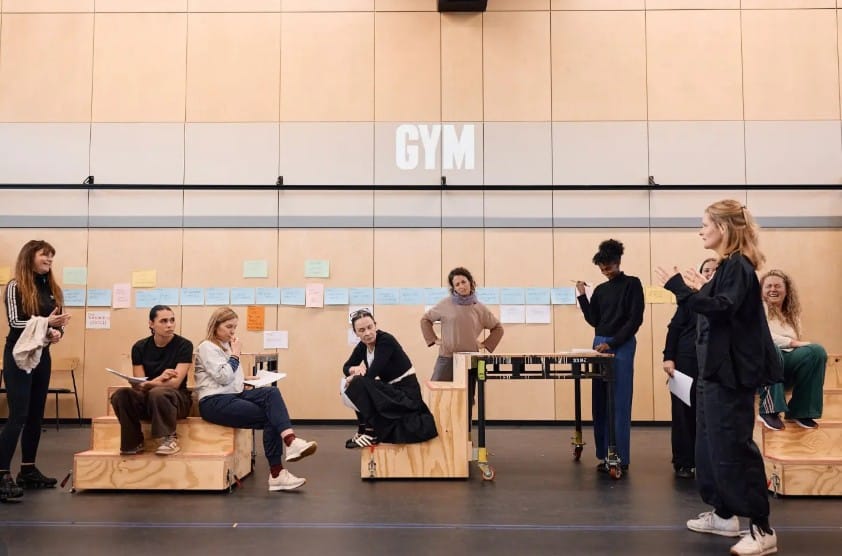
“This time we conceived the production that starts in a very empty space and the focus is really on the bodies in space. There are no rooms [on stage] per se, its very much about creating space through the actors’ bodies and locations through the active bodies as well.”
Staging: from idea to realisation
Giles joined the creative team after director Lee Lewis had to withdraw early in the process. I was interested to hear what it was like picking up the work from where someone else had left off. Remarking that Lewis had formed a brilliant creative team and cast by the time she came on board, there was no set design already in place. This allowed Giles to start from scratch and realise the concept in real time with the team. “This is very much one of those shows where you can do as much pre-thinking as you want but work like this has to be made in the room,” she says. “The room has to be like a profoundly collaborative, playful, risk-taking sort of space. I think the main thing is creating a space where people can have ideas, they can fail, they can succeed – it’s that politic of women collaborating.”
Describing how the rehearsal process unfolded, she clarifies, “we’re not trying to recreate football on stage. It’s more that we’re trying to recreate the spirit and ingenuity and audacity and tenacity of the women who started the AFLW on stage. The concept of how we approached it in rehearsals is starting with nothing and then building it from there.”
“The text provides a parallel visual storytelling as opposed to trying to recreate the energy of the AFL. The footy is more like a vehicle, because the play is really about how women come together to make things – how women come together and network, collaborate, and create space where there wasn’t previously space. And the AFLW is actually an incredibly inspiring story of how that happened. It becomes a brilliant example of how that was done and how that relates to a much wider political societal question about how do you fight for change.”
“There’s real whimsy in the staging – little sequences like super heightened, surreal theatricality, or moments of humour when we’re trying to find the unexpected way to stage that moment. Miller’s text doesn’t present a hyper-naturalistic, literal scene; all of her work requires decisions from creatives to rise to it and find interesting ways of revealing it. So it’s been a really different process, and so much fun.”
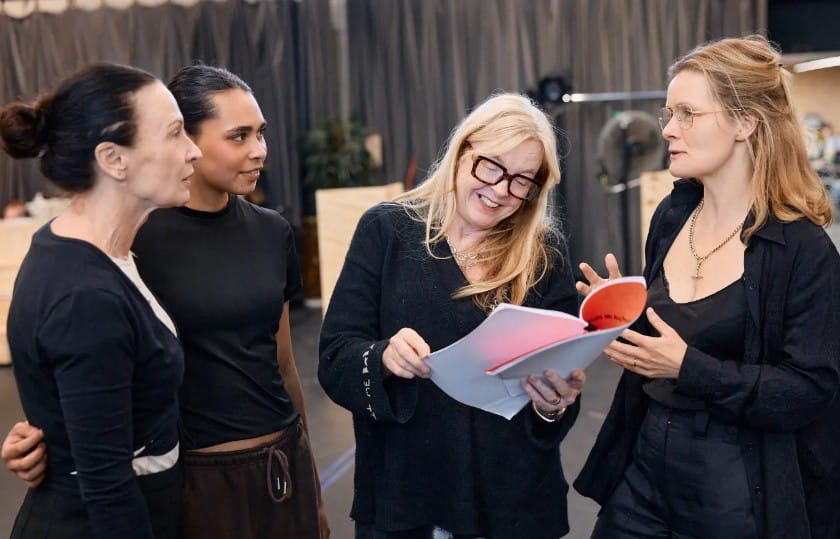
Tara Morice and Nyasha Ogden with Suzie Miller and Sarah Giles in rehearsal for Strong is the New Pretty. Photo: Daniel Boud
The collaborative rehearsal process
“Because Suzie’s a theatre animal, her writing always leaves space for the theatre itself – she doesn’t write a map of what the production is meant to look like. There’s an understanding that it will continue to grow and evolve” Giles remarks. “To an extent, a lot of Suzie’s work has a real post-dramatic quality to it, with vignettes that require decisions to be made or have other things around it. There’s so many different ways of staging it, I think anyone who picks up the script would do very different things with it.”
Giles discusses how collaborative the rehearsal process has been, noting how Miller’s openness and willingness to give anyone’s ideas a try created a sense of fearlessness in the room. Some playwrights will include specific stage directions and parameters, but Giles iterates that hasn’t been the case here. “It doesn’t work as well when you’re in a place where you’re trying to please or trying to execute something that has an answer of right or wrong. But when there’s a space of true collaboration and risk, it’s a much more fertile space to make work from.”
“There’s a scene where two mothers are talking about the multitasking of parenting, and early on in the process I thought ‘wouldn’t it be interesting if they were doing jump rope while doing the monologues’. Then all of a sudden the jump rope communicates a certain level of multitasking that contrasts with what the text is saying. It shows the conflict relationship of tension that then creates a separate meaning for the audience.”
Why Suzie Miller’s works are so powerful?
“What’s really interesting and something I think Suzie does pretty regularly in her writing is how she takes specific examples that refract out and have a wider meaning – it’s why her plays have such wide-ranging success and politics inside them, because it speaks to more than just the subject matter. The subject matter is the vehicle for a bigger message, a bigger idea.”
“I think the last time I saw this many women on stage personally was when we did Accidental Death of an Anarchist at STC and I recast all the male roles as women” she says. “So politically, it’s really interesting from a structural perspective – to have that many women on stage literally creating theatrical images out of ostensibly nothing, using just ingenuity, creativity, curiosity and then slowly over time building those images to something very virtuosic.”
What do you hope audiences will take away from the work
“If you’re not interested in AFL, the play is still incredibly fascinating. It’s actually about how you start something from nothing and how you fight for equality and for space – so it becomes relevant to almost every aspect of society.”
Discussing why it will resonate with audiences today; she talks about how the work extrapolates a common female experience. “I think every woman who’s ever been in and had to navigate their way through a heavily male-dominated space knows that there are certain things that you’ve got to do in order to get where you need to go.
Women have to think outside of the box and be inventive to succeed; they have to navigate the rigid systems and structures that have been built by men, for men. This story is about how against all of the odds – success came from it.”
Strong is the New Pretty will premiere at Brisbane Festival, playing from September 1 – 19 then touring to Canberra and Geelong before its Sydney season.
A Brisbane Festival, Sydney Theatre Company and Trish Wadley Productions co-production, originally commissioned by Trish Wadley Productions