Type – Baroque music, staged cantatas, French and German Composers
If you liked – Barry Kosky’s Saul, Pinchgut’s Messiah, Giulio Cesare
A caffeine-fuelled, feather-ruffling performance
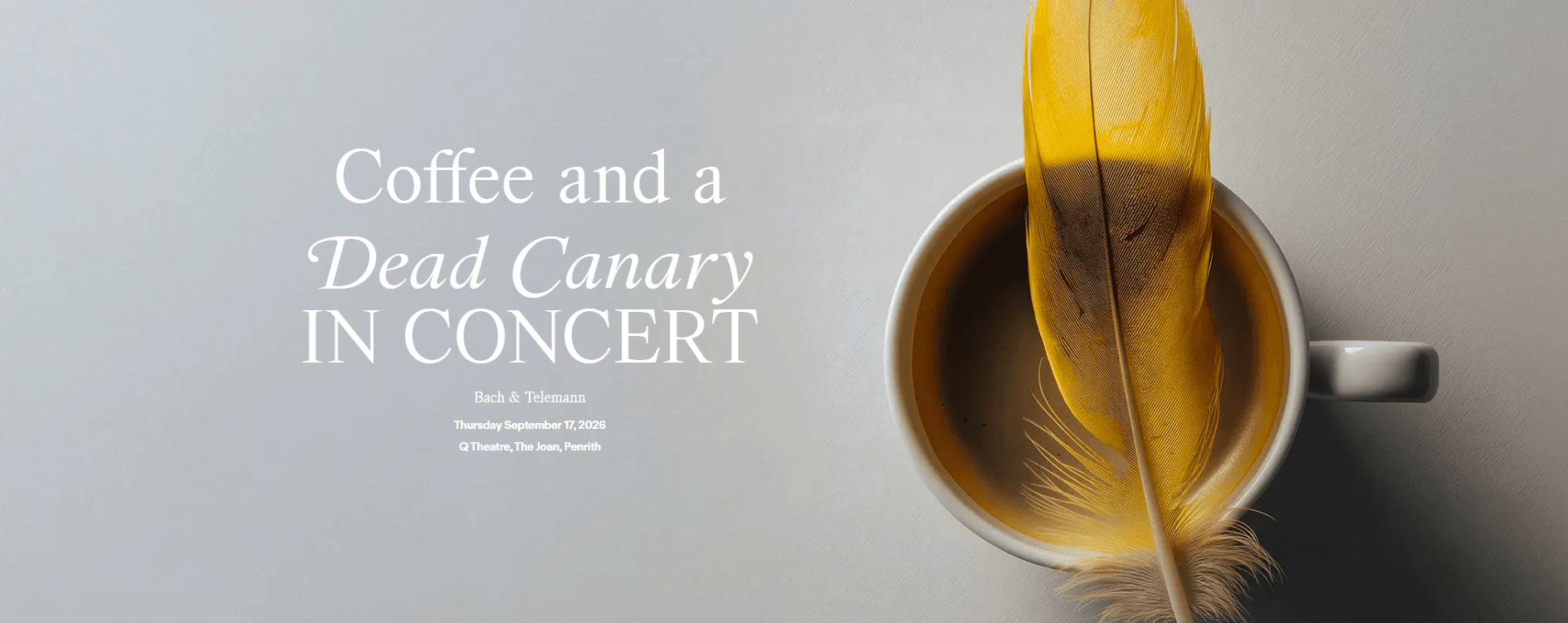
Pinchgut Opera’s latest production,Coffee and a Dead Canary, delivers a handful of infrequently performed 18th-century Baroque cantatas. At the time, coffee drinking was a new fad sweeping Europe and the caffeine culture saw the creation of European coffee houses which offered a new, communal space where people didn’t require a noble title to speak. The coffee houses soon became a place for intellectual and philosophical debate as well as casual space for amateur music performances, creating a massive cultural shift. Composing shifted away from sacred subjects and started focussing on the mundane and pleasures in life – enter coffee and a canary.
Led by Musical Director Erin Helyard at the harpsichord, the seven-piece Baroque ensemble from the Orchestra of the Antipodes are seated on a raised platform to one side of the stage. Melanie Liertz’s design features a large proscenium arch set on a diagonal angle. This brings the staging forward to create an intimate, triangular space that aids the connection between ensemble and the singers.
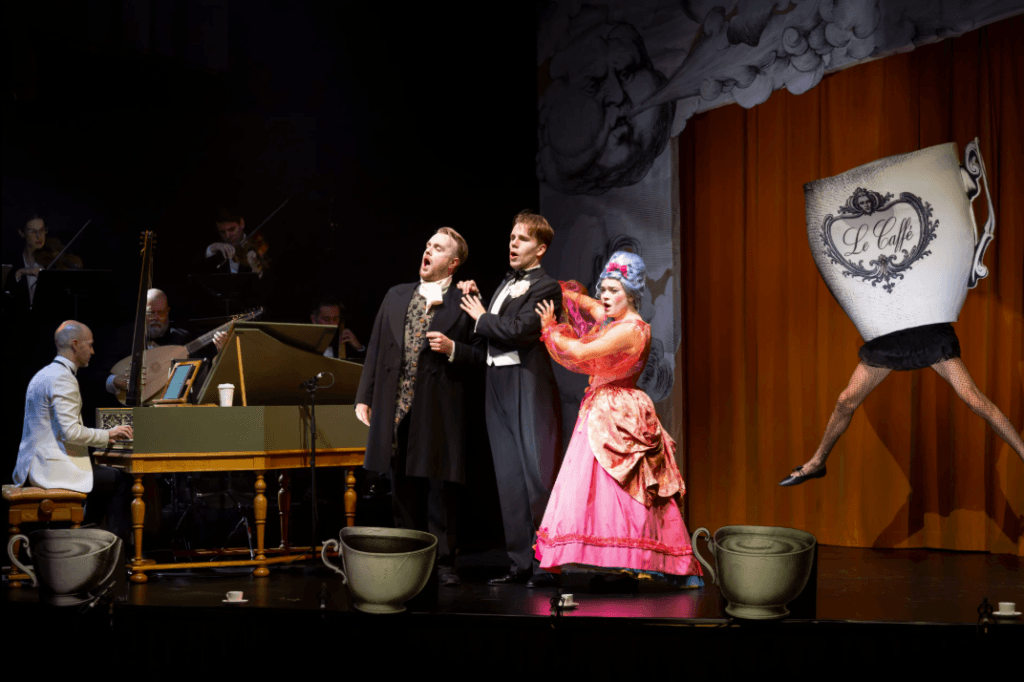
Directed by Eugee Lynch, the work begins with two pieces from the Court of Versailles. The production opens with Nicolas Bernier’s Le Caffe (1703). This work arguably set the standard for the French secular cantata; a genre designed as a mini chamber opera to be performed in Parisian salons. The work praises coffee over wine and has been used as a musical articulation of Western Europe’s shift from the Age of Alcohol into the Age of Reason
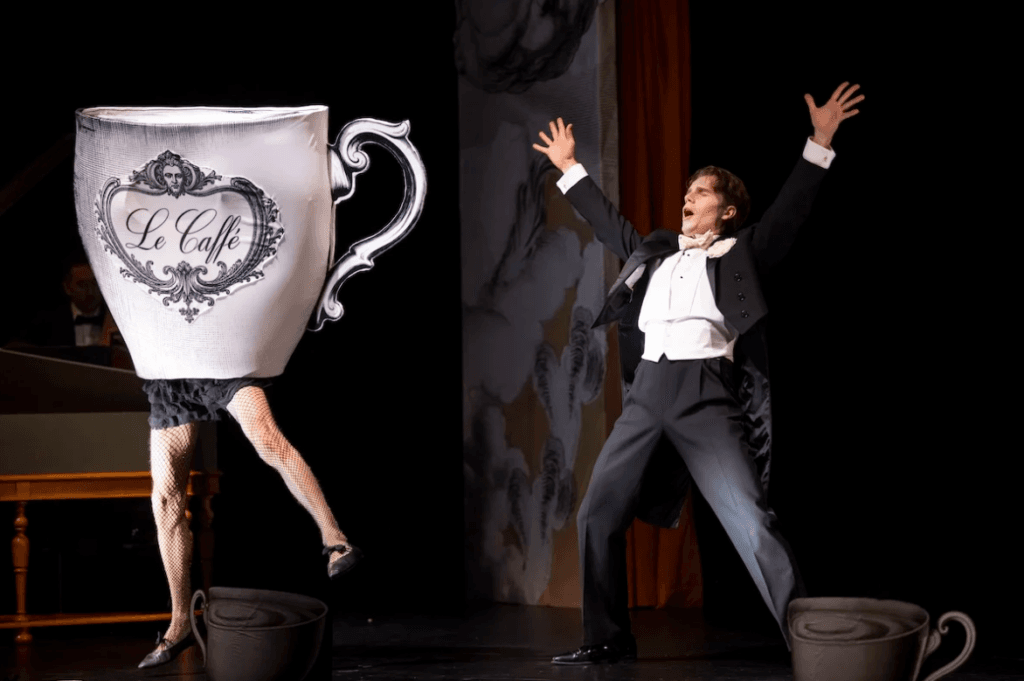
Originally written for a soprano, tenor Nicholas Jones performs the recitatives and arias with dramatic flair. Dressed in tailcoats, Jones is joined by other characters on stage to assist in playing out the dramatised context as well as a gigantic coffee cup, a character of its own that sees actor Mitch Riley donning a black tutu and fishnet tights under a foam-cup costume. Jones’s manic, caffeine-fuelled characterisation leans heavily into slapstick comedy, creating a highly physical, caricature-like interpretation that matches his vibrant vocal timbre.
Specialist historical flute performer Melissa Farrow leads Pierre-Gabriel Buffardin’s Flute Concerto in E Minor (1737). The expressive dialogue between Farrow on flute and Matthew Greco on violin subtly highlights the delicacy of the fluttering score. Riley returns, but this time as a human-sized canary. His physical embodiment of the music creates jittery and jolly storytelling through movement as he flitters around the theatre with playful pantomime audience interactions. While the direction and choreography provides great entertainment throughout, it does detract from the music during both pieces.
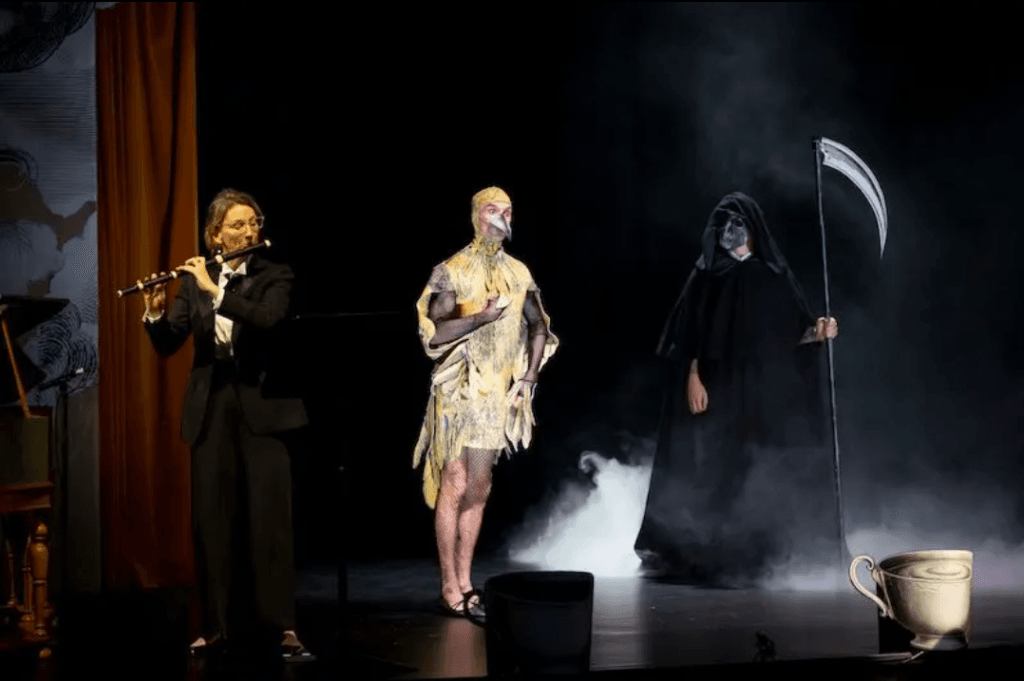
The repertoire then takes us over to Germany, beginning with Georg Philipp Telemann’s Funeral Music for an Artistically Skilled Canary (1734). Baritone Morgan Pearse brings much-needed emotional anchoring to the work and achieves this despite the inherent silliness of a text (that sees him attending his pet bird’s funeral). Hitting all the comedic notes with straight-faced commitment to the tragedy, he brings genuineness and depth to the mock-heroic comedy without undermining the music. While some of the coloratura occasionally gets lost in the venue’s acoustics from the back half of the stage, Pearse’s divinely rich and resonant tone is a true highlight of the production.
J.S. Bach’s Coffee Cantata (1734) completes the production, featuring a sparkling performance by soprano Ariana Ricci as the sassy and sharp Lieschen. Ricci’s luscious, crystal tone sails across the agile score with ease while maintaining floating legato lines. There is generous comic chemistry between Ricci and Pearse, who plays her overbearing father, Schlendrian. Wearing an iconic, hot pink Baroque dress detailed with sparkling pink organza flourishes, she establishes a gorgeous musical texture alongside Farrow’s consistently grounding flute line.
The musical vitality is matched by Véronique Benett’s lighting design, which effortlessly shifts the mood between pieces, intensifying the tonal changes and adding dramatic weight to the cross-era costumes. Underpinning the entire evening is the exceptional leadership of Erin Helyard. As always, Helyard shows a deep understanding of historical context, facilitating a feeling that the orchestra is a character in itself. His energetic leadership from the harpsichord actively propels the score with succinct, lively energy shifts.
Is COFFEE AND A DEAD CANARY Worth Seeing in SYDNEY?
Pinchgut Opera has brewed a joyful and jolly, historically informed hour (and a bit) of 18th Century music. While feeling a little unbalanced with the mismatch of baroque musicianship with slapstick comedy, the work gives a fresh vitality to a handful of brilliant but infrequently performed works.
Coffee and a Dead Canary played at City Recital Hall on September 11 and 12 and will be performing at Q Theatre, The Joan in Penrith on Thursday 17th September 2026
Tickets and Practical Info for COFFEE AND A DEAD CANARY in PENRITH 🎟️
75 minutes with no interval
Program
Nicolas Bernier Le Caffé “Coffee” (from volume 3 of Cantates française)
Pierre-Gabriel Buffardin Flute Concerto in E minor
Georg Phillip Telemann Trauer-Musik eines Kunsterfahrenen Canarienvogels “Funeral Music for an artistically skilled Canary” (TWV 20:37)
Johann Sebastian Bach Kaffeekantate “Coffee cantata” (BWV 211)
Cast & Creatives
Ariana Ricci – Soprano
Nicholas Jones – Tenor
Morgan Pearse – Baritone
Mitchell Riley (Mitch Riley) – Actor / Canary
Erin Helyard – Conductor / Artistic Director
Eugene Lynch – Director
Melanie Liertz – Designer
Veronique Benett – Lighting Designer