Type – Adaptation, Queer Work, Visual Feast
If you liked – Virginia Woolf, A Room of One’s Own (Belvoir St), Orlando (1992 Film)
Enriched by its decadent costume and lighting, this Orlando is joyously queer, even if it doesn’t reach its full potential
Virginia Woolf’s 1920’s novel, Orlando: A Biography takes a journey through time in a satirical exploration of gender, class and identity. It is itself a love letter to her romantic partner Vita Sackville-West, their affairs reflected in Woolf’s text and Orlando’s story. Orlando’s reality is one of poetry and adventure; it spans centuries and peers through societies. As a character, Orlando is fantastical, flirtatious and romantic. They are all of these at once and yet are not defined by any of them.
Woolf captures the limited scope of movement for women of the era – and of today – who sought a lifestyle beyond the realms of what was deemed ‘acceptable’ of the time. The dream of a life bigger than her own is etched into stone on Orlando’s pages. Carissa Licciardello (who also directs) and Elsie Yager’s co-adaptation of Woolf’s text condenses Orlando’s journey, keeping the essence of Woolf’s dream intact even if the themes it presents is a sometimes traditional one.
Orlando’s Design: Decadence, Decay and Technology
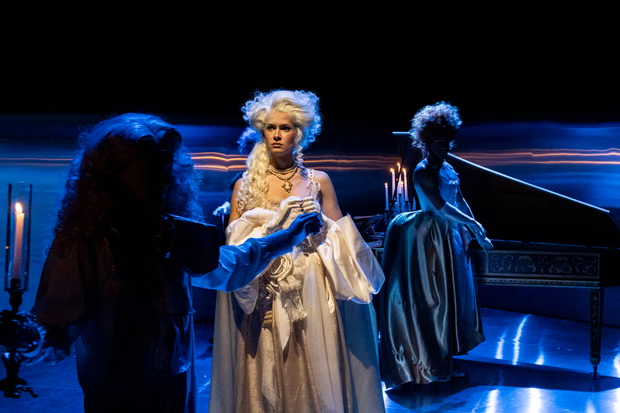
The limitless space of the theatre is a prime location in which Orlando’s story can be told. We move from the boyish beginnings of Orlando’s entrance into the Elizabethan court, where his fiery passion for poetry and love is lit. As the ages change, so does Orlando’s gender as we shift from revolutionary decadence, to pitch black Victorian attire before arriving in the modern technological age. The fluidity of Orlando’s gender is as shifting as the times in which they find their new self.
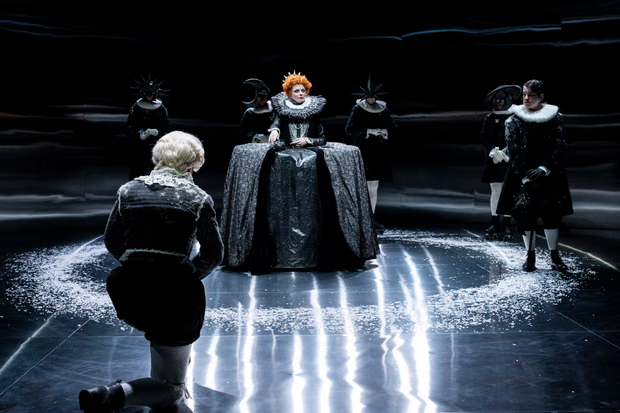
Nick Schlieper casts a blue-hued vastness over David Fleischer’s reflectively mirrored set as we begin in the icy cold winter of Queen Elizabeth’s reign. Snow forms a neat circle on the ground as the actors glide in and out on skates as easily as though it were ice; the notion of fluidity is established from Orlando’s beginning. Throughout, we’re treated to resplendent costumes by Ella Butler who captures each era with an intricate eye for detail and decadence when required.
Photograph: Brett Boardman
Orlando’s Celebrated Casting
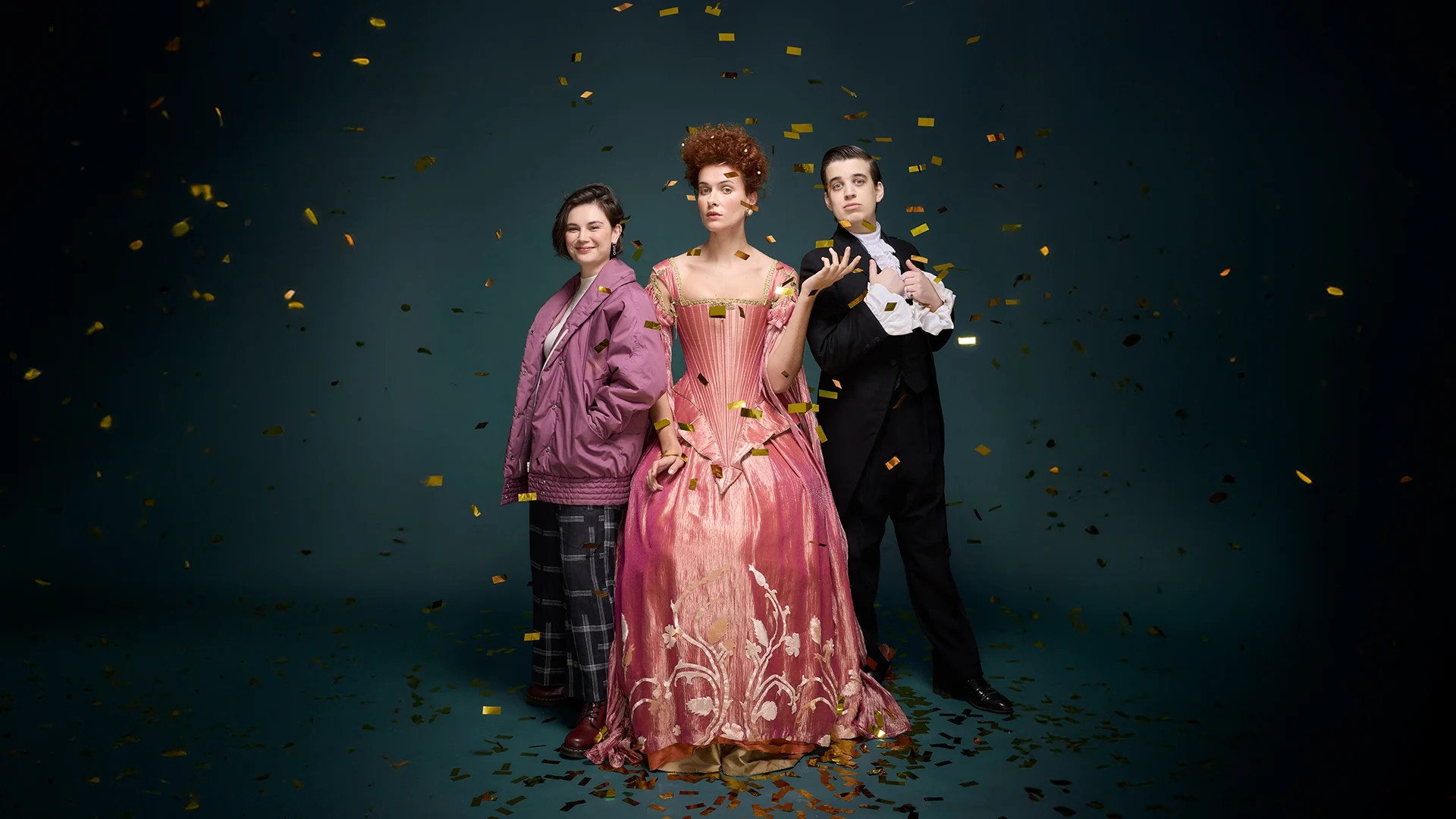
Like a certain time jumping Time Lord, Orlando is played by different actors, all of whom in this production are trans or non-binary – Shannen Alyce Quan, Janet Anderson, Zarif, and Nic Prior. Each leaves their mark, but it’s Quan and Anderson’s first act that is the most captivating.
Quan’s Orlando is baby-faced and inquisitive, he only knows the confines of the court and his duty to the crown. He dreams of adventure, but shirks from it when it holds open a door. The transition between Quan and Anderson is understated and warm. As they mirror each other’s movements, we feel the passing of time as Schlieper’s blue hues become amber liquid before fading into an intimate gold. It’s perhaps the most vital moment to keep the audience on the journey and it succeeds.
Anderson’s Orlando revels in her new body as she laughs at the frivolous nature of men before discovering the boundaries society places her in. Anderson’s inherent charm seeps through Orlando’s pores, particularly in her natural flair for comedy. She carves a presence that lingers when Orlando’s new form takes over.
Orlando’s second act, does it stick the landing?
As the play enters its second act, it starts to enter a territory of didacticism. Yager and Licciardello trim much of Woolf’s original text in their adaptation, but the 105 minute runtime is most definitely felt as its structure becomes repetitive. Zarif’s Victorian era Orlando is met with dialogue that retreads upon itself, as the script becomes almost sermonic. The discovery we journeyed with in the first act with Orlando is gone, and the new perspectives march on less lightly. It’s almost as if the two acts were directed by different people.
As we enter the contemporary underground of the London tube, Prior’s Orlando takes a back seat and instead we’re shown a somewhat relentless montage of characters and situations that feels at odds with the rest of the makeup of the piece. Yes we see how the world of gender has changed, but we don’t see where Orlando fits into the fully realised picture. The final image, however, leaves a lasting impression of Orlando’s true essence and exudes beauty.
Is Orlando Worth Seeing in Sydney?
Orlando’s conventionalism is found as Orlando accepts who they are, rather than explore the notion of their gender in the societies they shift into. It tends to lose its profundity in this later half and with it, its potential for awe and excitement. What could have been a moment of traditional breaking of form is instead restrained. The production remains nonetheless insightful and entertaining, but I can’t help but feel it has more potential.
Photograph: Brett Boardman
Tickets and Practical Info for Orlando in Sydney🎟️
Belvoir St Theatre, Upstairs
Until: 28th September
Tickets: https://belvoir.com.au/productions/orlando/
Cast
Janet Anderson – Orlando 2 & Others
Nyx Calder – Nicholas Greene & Others
Emily Havea – Sasha & Others
Amber McMahon – Queen Elizabeth & Others
Nic Prior – Orlando 4 & Others
Shannen Alyce Quan – Orlando 1 & Others
Zarif – Orlando 3 & Others
Creatives
Virginia Woolf – Original Author
Carissa Licciardello – Director and Co-Adaptor
Elsie Yager – Co-Adaptor
David Fleischer – Set Designer
Nick Schlieper – Lighting Designer
Ella Butler – Costume Designer
Hailley Hunt – Associate Costume Designer
Alan John – Composer
Kelly Ryall – Sound Designer
Sam Cheng – Associate Sound Designer
Shannon Burns – Choreographer
Ayah Tayeh – Assistant Director
Laura Farrell – Vocal Coach
P. Tucker Worley – Roller Skating Consultant
Brooke Lee – APT Dramaturgy Associate
Luke McGettigan – Stage Manager
Estelle Gomersall – Assistant Stage Manager