
Type – Classical revival, movie-to-stage adaptation, large ensemble numbers
If you like – The original 1964 film My Fair Lady, Oliver, golden age musicals.
My Fair Lady: While stunning in its production quality, it may stun audiences for entirely different reasons in its content.
The longstanding partnership between John Frost and Opera Australia has resulted in over eight major musicals being brought to Australia over the last 15 years. In 2026, their partnership continues with the return of Lerner & Loewe’s My Fair Lady.
The classic musical centres around Cockney flower-seller Eliza Doolittle and Professor Henry Higgins, a phonetician who, over the course of the two acts, attempts to redefine how she speaks so she can pass as a “lady”. Some audience members may recall the 1964 filmadaptation, starring Audrey Hepburn, which went on to win the Academy Award for Best Picture. The production also marks 70 years since the musical’s Broadway debut.
This production, now playing at the Ian Potter State Theatre is the return/semi-revival of the 2016 Australian production directed by Dame Julie Andrews. This continuity was evident in the return of most of the original creative and design teams, alongside four leading cast members.
In her direction, Karen Johnson Mortimer made the choice to maintain the established approach that Andrews had set out previously. While undoubtedly a part of the 2026 production’s construction, producing this revival does raise questions as to how much responsibility contemporary productions have to reconsider the material they are bringing back to the stage.
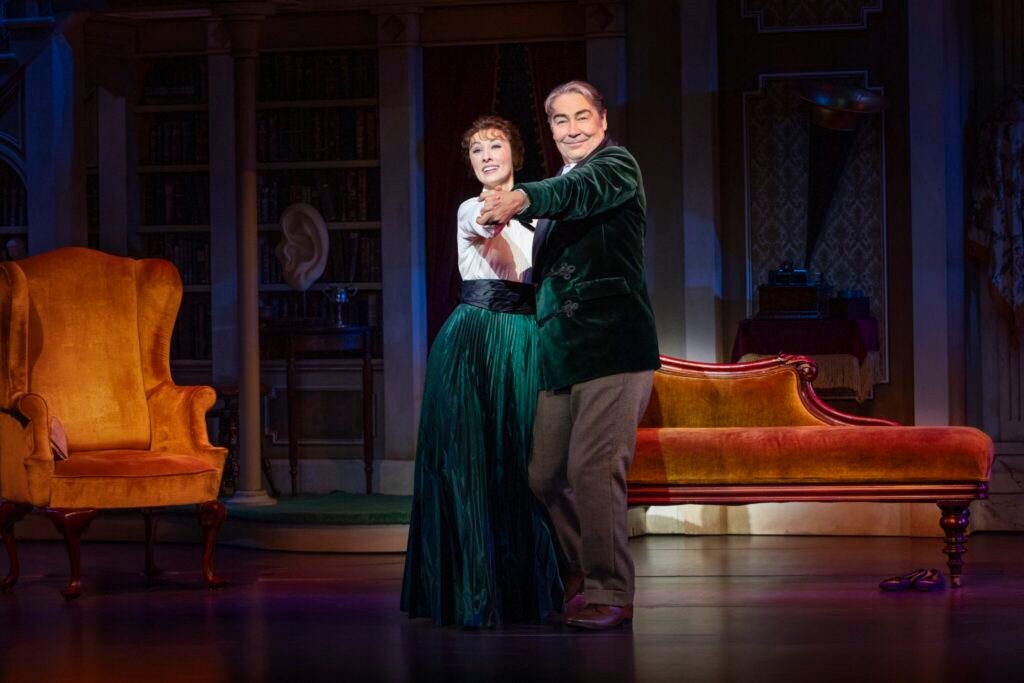
In terms of practical staging, the proscenium arch was positioned halfway up the full height of the stage, creating a performance space that felt more confined compared to the theatre’s dimensions. Oliver Smith’s grandiose set, which brought on applause near the end of act one, felt ultimately restricted within the available space, and longer blackouts for transitions impacted pacing and immersion.
As with the touring nature of this show, it is understandable that proportions had been adapted for portability. However, when considering the scale of the theatre, with its dress circle, balcony and upper boxes, this arrangement does raise questions about the viewing experience from different areas.
The story of My Fair Lady was written during a very different social climate to ours today, and much of this content remains embedded in the original book and lyrics. Higgins’ behaviour towards Eliza consists of unrelenting offensive descriptions such as “baggage”, “gutter snipe” and a “brazen hussy”. There are also clear instances of gaslighting in nature when he stresses for her to be thankful for his behaviour when she eventually stands up to him.
The audience reactions to these scenes, of which there are many, were of shock, disapproval, and often horror that this was playing out in front of them. Tonally, My Fair Lady has always been interesting to place in terms of whether the sequence of events is a purposeful sign of the times, or an invitation to see the arc that Higgins goes on as one to empathise with (the latter is very difficult in 2026).
Whatever reservations one might have about the material, this show’s cast is deserving of considerable recognition.
Claire Lyon is mesmerising as Eliza. From her proud nature of selling flowers in Covent Garden to make a living, through to her tentative transformation into a product of higher society, Lyon’s vocal agility and accent work compliment her portrayal of both sides of the character’s journey.
Interestingly, Lyon is not the last to bow for this company, with this instead going to Nathaniel Parker as Higgins. Parker is utterly convincing and detestable as the Professor-but in such a way that some of his numbers are rather hilarious. It’s the commitment that he holds to playing such a horrible person such as Higgins, and the energy and stage presence that he commands which really make this character who he is.
Among the company members reprising their roles in this production were renowned performers Reg Livermore as Alfred P Doolittle and Robyn Nevin as Mrs Higgins. Receiving well-earned rounds of applause on their first entrances, each of these actors gives a performance that justifies such a reaction. Nevin’s cool, calm, and collected nature when dealing with her onstage son delivers some major relief to the audience, and her time onstage is a major highlight.
Livermore’s rousing number “Get me to the Church on time” was the uncontested favouriteof the night, with an ensemble of triple-threat performers bringing Christopher Gattelli’s high energy choreography to life.
A special mention must go to Freddy Hellier as Freddy Eynsford-Hill who delivered the most beautiful rendition of “On the street where you live”. His vocal tone was perfectly suited to the song, and it is clear Hellier is one to watch with this reportedly being his Australian mainstage debut.
Is My Fair Lady worth seeing in Melbourne?
For the cast performances and moments of elaborate set design, this show absolutely delivers. However, it is up to audiences whether they wish to undertake consideration of the show’s age and the context of the original material – particularly in its male antagonist – before seeing this production,otherwise you may be in for a shock.
Tickets and Practical Info for My Fair Lady in Melbourne 🎟️
Ian Potter State Theatre-Arts Centre Melbourne
Season 14 th of November– 17th of January
Tickets: https://myfairladythemusical.com.au/
Music by Frederick Loewe, book and lyrics by Alan Jay Lerner