Type – Historic drama, Classical Music, Witty
If you liked – Amadeus, The Habit of Art, Captain Corelli’s Mandolin
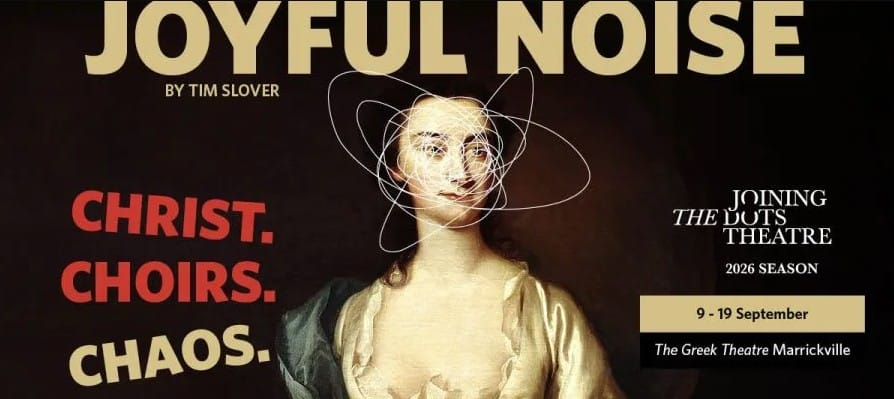
Joyful Noise: Bankruptcy, duelling divas and an uncompromising church bishop, the drama behind Handel’s Messiah
Whether they know who wrote it, most people are instantly familiar with George Frideric Handel’s iconic Hallelujah chorus. Yet, few know the turbulent, scandalous, and fiercely political history behind its inception. Written in 1998, Tim Slover’s Joyful Noise is a comic, witty, and spirited celebration of the rule-breaking genius behind the creation of Handel’s Messiah. The work focuses heavily on Handel’s chaotic personal life and his desperate bid to stay culturally relevant and gainfully employed in the early-to-mid 1700s.
Before moving to London in his 20s, Handel had firmly established himself as a composer at home in Germany. He relocated to the UK to write opera for the commercial theatre, nobility, and the royal family. However, thirty years later, an economic crisis and the waning popularity of opera left the great composer nearly bankrupt.
While a massive, untapped audience existed within the rising English middle class and the religious public, Handel faced a massive roadblock: the Church. The Bishop strictly forbade secular, profit-driven theatre from being acted out on a stage if it contained sacred texts. To bypass this ban, Handel presented The Messiah strictly in a concert format, successfully inventing the genre of English Oratorio.
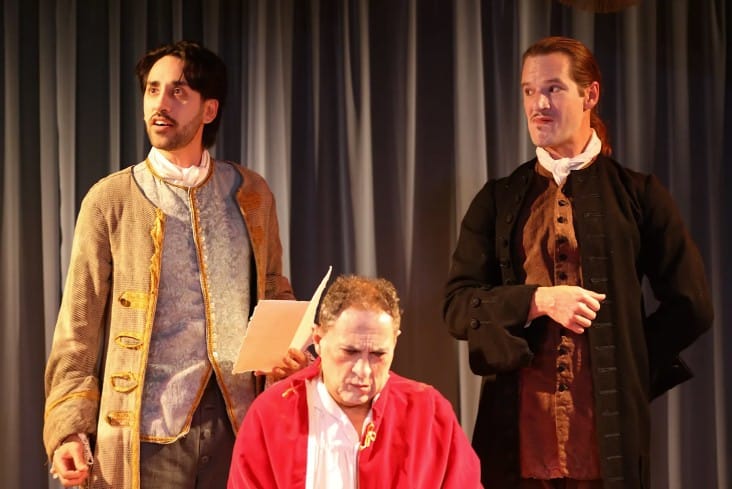
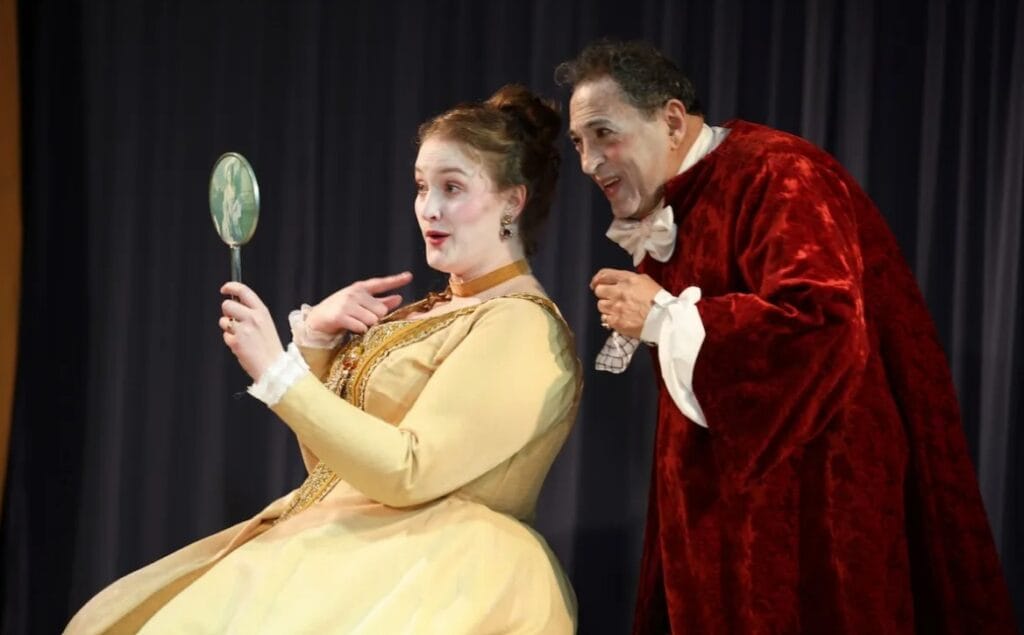
Director Madeleine Stedman elegantly utilises the intimate space of The Greek Theatre in Marrickville. Stripping away modern dependencies, the production relies on the natural acoustics of the room without the use of microphones. The period costumes inject great drama and historic context into the work and Stedman’s direction infuses many comic flourishes throughout.
The simple, resourceful staging relies on an upholstered wooden bench to seamlessly signal scene changes involving the King. The direction leans into tongue-in-cheek physical comedy—particularly in a scene where a heavily cloaked item is cautiously brought onto the stage, only to reveal a miniature piano.
Some of the staging feels slightly incongruous, notably in the final scene that includes Handel’s conducting of the Messiah in London. The theatrical setting sees the two female singers on either side of the stage, spotlit with the other characters facing the audience from the back of the setting. While visually cohesive and theatrical, the staging of this scene feels somewhat unclear with Handel conducting facing the audience and the other members of the ensemble have his back to them.
Charlotte Leamon’s sound design incorporates snippets of Handel’s compositions including Water Music and Eternal Source of Light. These pieces are played on what sounds like a synthesised, electronic harpsichord which feels like an unusual choice and detracts from the otherwise organic, analogue texture of the production.
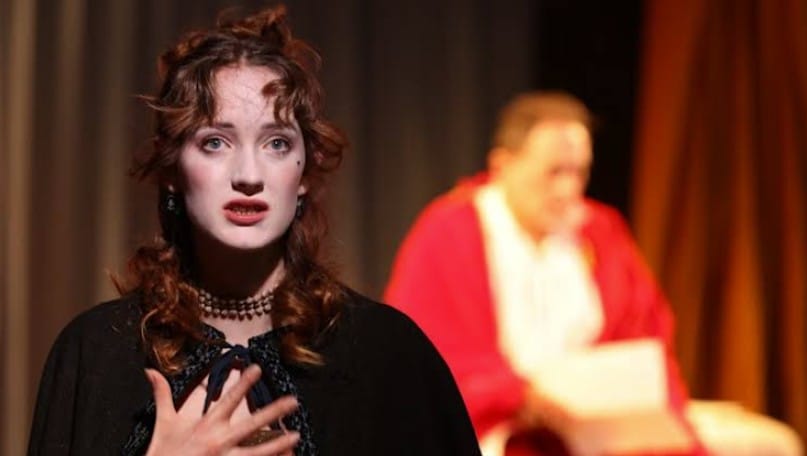
The ensemble cast breathes vibrant life into this historical comedy. As Handel, Nicholas Papademetriou balances sharp wit and warmth with stubbornness and crabbiness. He carries Handel’s underlying creative passion, capturing a man both comically frustrated and profoundly expressive. Laila Chesterman portrays Handel’s favourite opera singer Susannah Cibber who was involved in a predatory sex scandal orchestrated by her abusive husband to pay off his debts. Though initially soft-spoken, Chesterman builds her portrayal with an empathetic warmth that wins over the audience. Angela Johnston delivers a wonderfully rambunctious portrayal of Kitty Clive the cockney soprano from Drury Lane. Leaning heavily into the “drama queen” soprano archetype, Johnston’s exaggerated, slapstick interpretation garners many laughs. Mason Phourmirath and Lloyd Allison-Young bring great physicality to their roles, spending much time on stage with smaller speaking roles. The rest of the cast including Alison Chambers as Mary Pendarves and Christopher Stollery as King George II deliver committed and entertaining performances.
Is A JOYFUL NOISE Worth Seeing in SYDNEY?
Leaning into the humour and humanity of Tim Slover’s text, the team present a night of historic comedy, an entertaining and a refreshing look at how artistic desperation can yield timeless brilliance.
Tickets and Practical Info for JOYFUL NOISE in SYDNEY 🎟️
Playing at The Greek Theatre Marrackville until 19 September
Duration 2 hours 20 minutes with one interval
Madeleine Stedman — Director
Mia MacCormick — Production Designer (Set & Costume)
Ashlyn Gill — Stage Manager / Lighting
Nicholas Papademetriou — George Frideric Handel
Laila Chesterman — Susannah Cibber
Angela Johnston — Kitty Clive
Christopher Stollery — King George II
Matthew Abotomey — Bishop Egerton
Lloyd Allison-Young — John Smith
Alison Chambers — Mary Pendarves