

Type – Theatre, Drama, Family, War
If you liked – Counting and Cracking, Death of a Salesman
The Jungle and the Sea: Epic in scale, intimate in grief — Shakthidharan and Flack’s Sri Lanka finds its most powerful stage yet.
War turns the most normal things extraordinary and the extraordinary into normal. When the simple act of wanting to conduct proper funeral rites for your family member turns political, you know you’ve lost the plot as a society. “I am just doing a normal thing” mumbles Abirami as she comes face to face with the army in act five of S. Shaktidharan and Eamon Flack’s grand Sri Lankan epic, The Jungle and the Sea.
Patrons were left drying their eyes on opening night and staring into whitespace pondering about the kind of world we live in, which for all its advancements in technology and industry, also sports a dark underbelly of a people ravaged by war, families torn apart, and a life unlived.
The Jungle and the Sea is a story of one such family who are pushed to the limits. Just like the way ‘safe houses’ and ‘bomb-free zones’ start with hospitals and schools in the inner city, then slowly move outward to the fringes, and finally to the beach, the family also finds itself being ripped apart from its core with its members separated across continents; yltimately to places they cannot come back from.
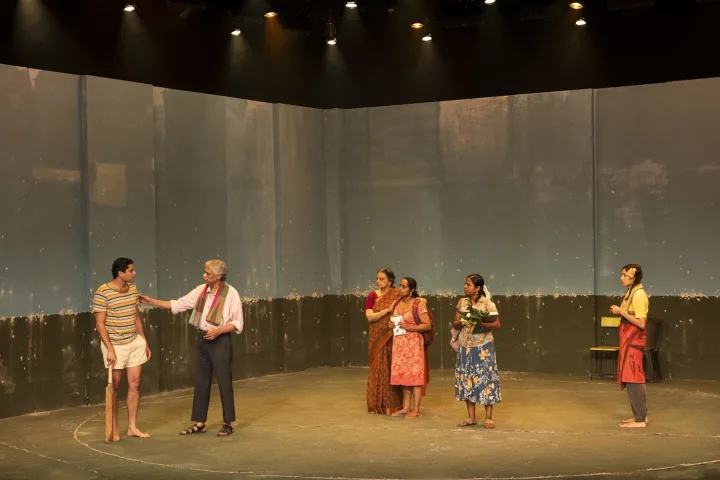
Dale Ferguson’s set portrays ‘bleak’ starkly and with purpose. The set comprises an L-shaped wall in the background. Littered with dirt, chipped paint, and the handprints of people, it represents and encloses various things through the five-act play. Damien Cooper’s lighting work turns this simple set into different things – the inside of the house, the rolling landscape as the family moves around, a battlefield riddled with chaos, and even sunny Sydney with a view of the Harbor Bridge from Bennelong. The rotating centre on the stage where most of the action happens, apart from being a clever technique to stage a play about ‘moving’, also quietly shows how the Sri Lankan people had no choice but to keep moving with the events happening around them. If they chose to stop or take a break at any point, the world did not stop with them; instead they were dragged along, whether they liked it or not.
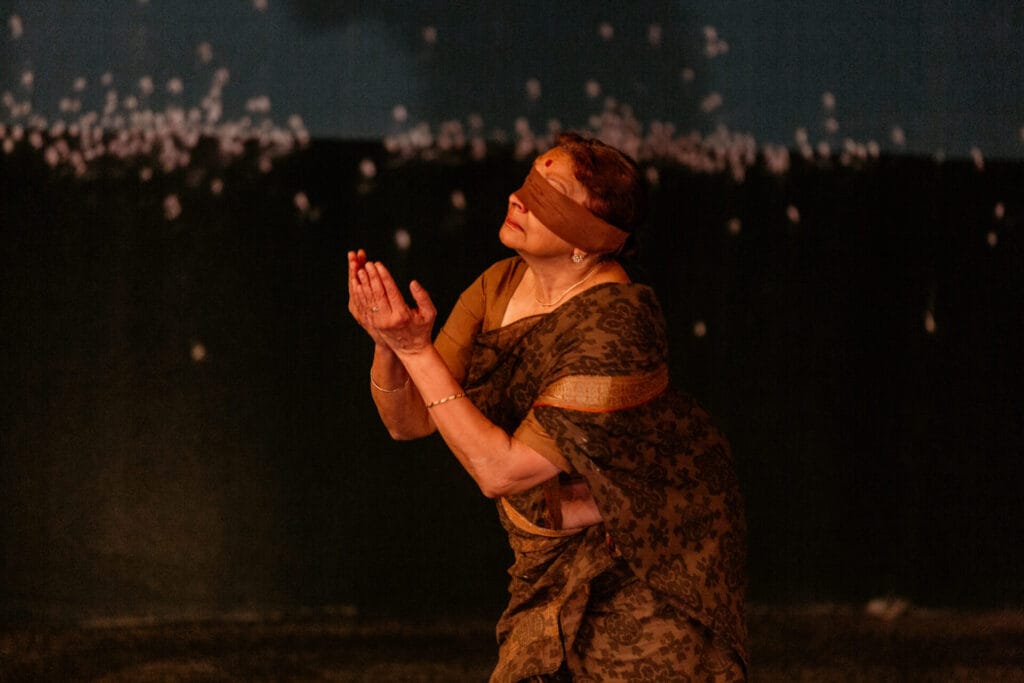
The much-revered Anandavalli plays Gowrie/Amma, the centre around which the play as well as her family revolves. As her youngest son leaves them to join the tigers, she applies a blindfold to her eyes that she vows to take off only when she sees all her children together again. It is an act borne as much out of despair as out of defiance. This is not the Sri Lanka she knows, and shunning it from view is, in her view, a rejection of the state it has gotten itself into. In Anandavalli’s Amma, one sees the trials and tribulations of all the mothers who have loved and lost in Sri Lanka during this period, but who still somehow find the shakthi in them to keep going.
What is unseen and only heard is often scarier than the real thing. Your mind fills in the blanks for what it cannot see, and this becomes most clear in the performance of Kalieaswari Srinivasan who plays Abi/Abirami, who has stayed behind with their mother, and who also plays the ‘eyes’ of Gowrie (as well as us in the audience) as she paints the scenes of a post-civil-war landscape with much weight. Srinivasan is headstrong, resilient, and her presence on stage is powerful as she balances resisting authority with the very real struggles of navigating a war-torn landscape. Nadie Kammallaweera‘s Madhu doesn’t get much room to work with, but she holds her own in the scenes she’s given.
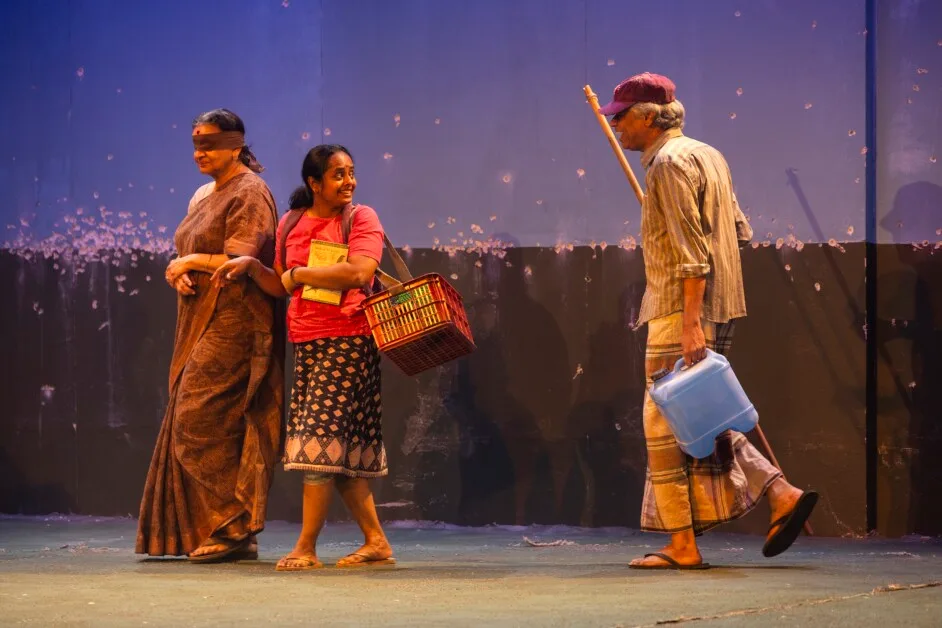
Emma Harvie plays Lakshmi who leaves for Australia with her father and becomes a lawyer. She brings a genuine ‘torn-between’ energy of someone who’s almost living two very different lives in different countries. Her bond with her Appa is endearing as she drags him into the twenty-first century with its weird and wonderful oddities, but also continues to be pulled back into what they’ve left behind in their homeland.
Prakash Belawadi is impressive as ever as Siva/Appa. Having been put in a position where he has to leave his family and move to a starkly different country and culture, Siva dotes on his daughter Lakshmi and longs to one day see the family he’s left back home. In a performance dominated by its female characters and actors, Belawadi’s Siva stamps his presence with a moving, powerful portrayal of a husband and father who has lost no less.
Some of the weaker segments of the play come with the scenes of Kishan and Himal, the father-son duo, two characters who remain underdeveloped throughout the play. The discourse between them in the final act about how no one side is better than the other is relevant, but gets a tad too prescriptive, and the essay-like delivery causes the finale to drag on, taking away from the punchiness of everything before.
Is The Jungle and the Sea Worth Seeing in Melbourne?
This play is worth watching purely for the experience of the live music, staged and composed by the acclaimed Arjunan Puveendran, and co-performed with Aswin Selvanathan. Arjunan brings ragas, thalas, notes, sounds, words and rhythms to life with the help of the veena and the mridangam, two instruments in Carnatic music. These are intentional musical choices, ones that are rooted in the instruments’ connection to the earth, a theme that’s central to the play. Arjunan also brings in vocals at critical moments during the performance, and it makes for an experience that merits catching it live.
Gowrie returns in the final scene to take the blindfold off. What’s in front of her is not the picture she expects to see; this war has changed so many things around her and even her own self, but the shakthi in her persists, and she performs the same dance she begins the play with, changed now—a gesture amended here, a new one added there—as the curtain slowly falls.
Tickets and Practical Info for The Jungle and the Sea in Melbourne 🎟️
Venue: Southbank Theatre, The Sumner
Dates: 14 Aug — 12 Sep 2026
Approx. 2 hours and 50 minutes, including 2 intervals
Tickets: https://www.mtc.com.au/plays-and-tickets/whats-on/season-2026/the-jungle-and-the-sea
This production contains themes of war and trauma, sounds of artillery, the use of haze and loud sound effects. For detailed information about the production’s content click here.