Type – Pulitzer Prize Winning, Linguistic, Belonging
If you liked – Bengal Tiger at the Baghdad Zoo by Rajiv Joseph, Wish List by Katherine Soper
English: The script is worth the price of admission alone.
Note: This review is written from the very first preview of the production and as such the elements within may very well have changed since its opening night.
They say that language is currency. If that’s the case, then English is the American Dollar. Language as a form of currency can be instrincally connected to a sense of belonging. To feel alien, an outsider, othered in a country you’re not native to puts you one step behind the rest. You may hold a doctorate in some fancy degree, or be the kindest, and most empathetic person in the world, but if you can’t speak the native tongue, then noone will ever know. Sanaz Toossi‘s Pulitzer Prize winning play, English, explores this and more through the lens of four Iranian students and their teacher.
Set in 2008 Iran, four students are studying to take the TOEFL (The Test of English as a Foreign Language) for their own varying reasons. Under the disciplined hand of their teacher Marjan (Nicole Chamoun), we are witness to the slow unravelling of their journey across the six week course. If you were to play a drinking game with English and take a shot every time the characters said the word, “English”, you’d be on the floor before the first half has come. English is at the centre of the work in a literal, metaphorical and metaphysical sense.
The first hurdle of tackling English is establishing Toossi’s tool of differentiating between the broken English that the characters speak and their speaking of Farsi in the actor’s local dialect. So the first two to three scenes of English was me piecing together which was which. Chamoun’s Marjan speaks with the accented English in class to encourage her pupils to do the same. Minerva Khodabande‘s young and spirited Goli is perhaps the easiest to follow in the disparate gap in her sharp, overaccentuated pronunciation of English. Others take a while to hear this difference, some which pay off later in the plot, others which just required a more definitive distinction from the get-go.
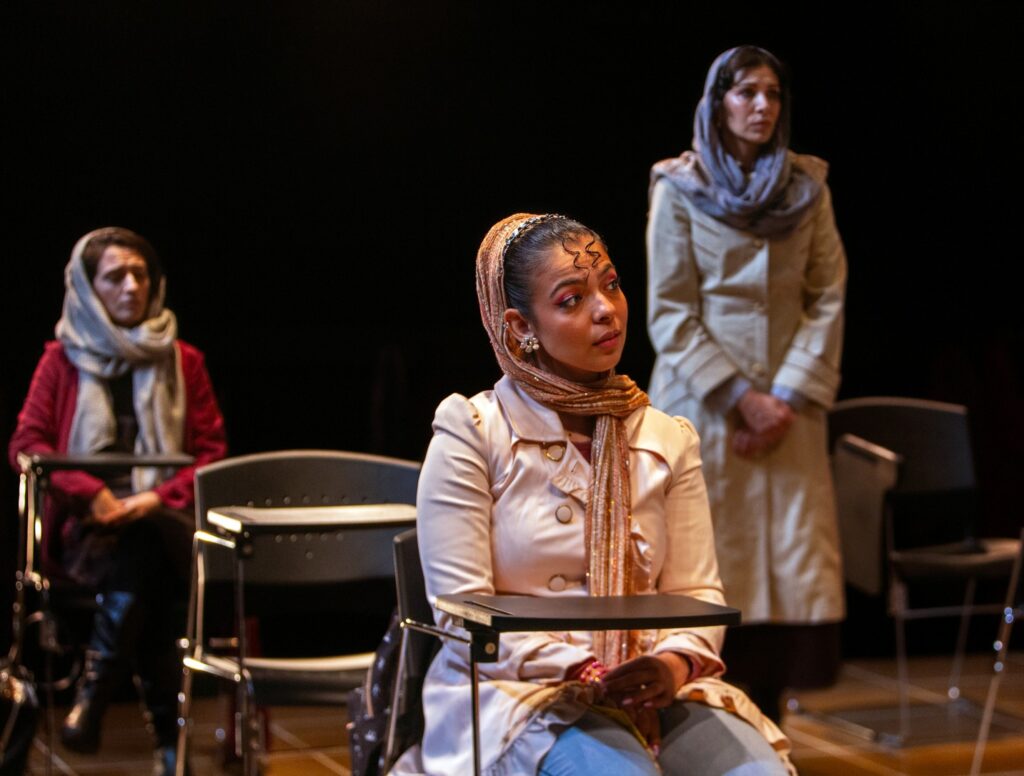
Perhaps this is purposeful, throwing us off balance like the pupils. I can speak from experience that teaching English is – at the best of times – the most infuriating language to teach with its many contradictory rules, reasons and those blasted homophones.
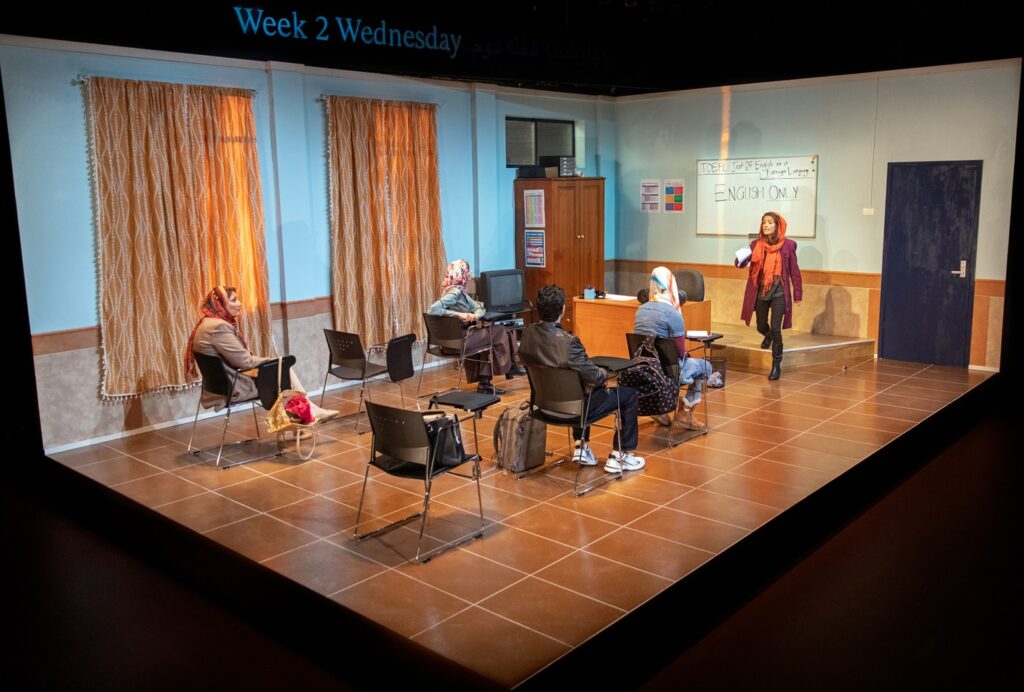
This need for immediate clarity feeds into the pacing of Craig Baldwin‘s direction, which felt overtly slow for the punchy comedy that’s embedded in Toossi’s script. Over the six weeks of English‘s world, we play witness to a vignette of scenes, some which move at a cracking pace. The scene changes between them feel overly complicated as the actors repeatedly moved the chair-tables around Soham Apte‘s viscerally real set.
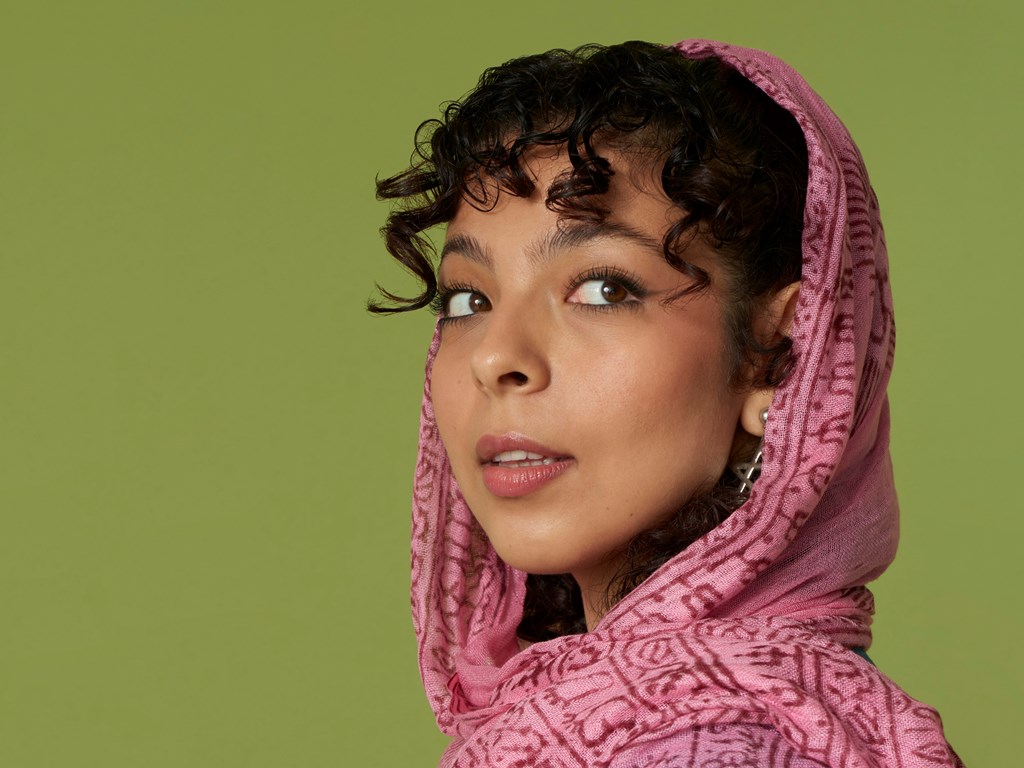
The students’ desire to learn English all fall to their own goals on what the English currency can buy them. For Goli, it’s a life abroad, schooling in America that opens the world to her. Khodabande is a beacon of joy on the stage, imbuing Goli with a burning optimism that shines in her scenes. Opposite Goli, Elham (Setareh Naghoni) is more stoic in her approach to the class. She despises the need to learn English and shed a piece of herself in the process just so she can be seen for the brilliant mind she is – and to be deserving of her acceptance to study at Melbourne’s RMIT. Despite Naghoni‘s more drawn in performance, often being so subtle it leaves the audience wanting more – there’s an underlying honest brutality and her fiery passion for Farsi that shines through.
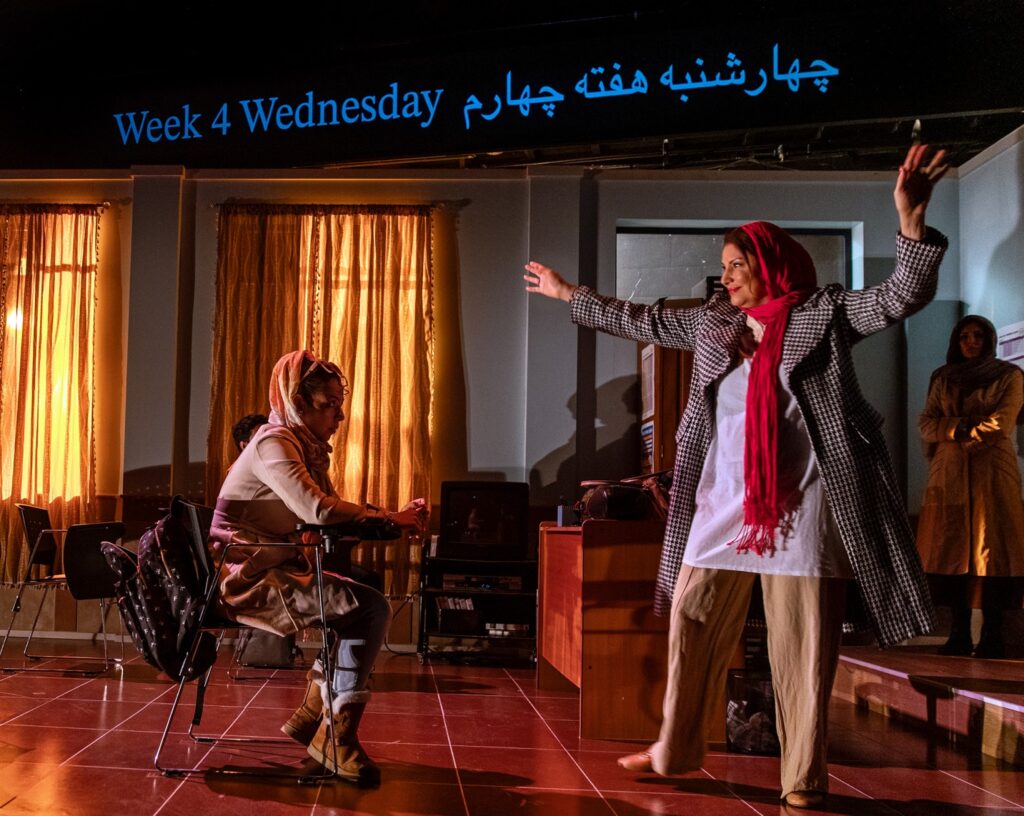
For Neveen Hanna‘s Roya, English gifts her the chance to speak to her Granddaughter in Canada. With a son that’s dodging her calls, Roya is preparing to move to Canada to live with her family. But how can she live with them when she can’t even pronounce her own Granddaughter’s name? Justice for Roya I say!
Perhaps the most central relationship on stage is between Charmoun’s Marjan and Pedram Biazar‘s Omid. There’s a lot of unspoken subtext to their interactions with Marjan having lived abroad and returning for reasons she won’t fully explain, and Omid who’s near perfect English will hopefully land him a visa to live in America. They share conversations over British rom-coms, ironically entering a potential will-they-won’t-they space, themselves. Charmoun gives us a concrete and complicated character on which the play revolves. She holds a sharp and barely hidden distain for speaking in Farsi, hiding it under the guise of a teaching method. Opposite, Biazar feels more restrained, and often a bit too wooden under Baldwin’s direction, particularly towards the climax which should have left a heftier punch in the show’s atmosphere.
With Madjid Alaei‘s cultural consultancy on English, articulate brush strokes have been layered over the top of the piece, which help to pull out the richness in Toossi’s words. But I can’t help but feel a disconnect. There’s a subdued quality to English that feels like its yearning to be set free. Rita Naidu‘s impeccable costume design adds colour and contrast to the scene, illustrating the sense of time passing as headdresses change frequently on the women. Spencer Herd‘s lighting design offers glimpses of creativity as auburn sunset seeps through the back windows to cast characters in shadow. The key elements are all there, so hopefully they fall into place after opening night.
This burning desire to belong, to be seen and to be – quite literally – understood is at the heart of English. The play is not didactic in its politics, nor does it feel overtly political, but staging English in the current news cycle most definitely is. When the Iranian people are being silenced online, bombarded by foreign attacks, or threatened by a world leader in a way that amounts to war crimes, this burning desire from its characters and its language could have been a wildfire in its purpose and, ultimately, its impact.
Is English Worth Seeing in Sydney?
The foundations of English are worth the price of admission alone. Sanaz Toossi’s script is uniquely layered as his characters are stripped back throughout. Our five Iranian characters represent and speak to so much of the immigrant experience, and the authentic casting helps to bring this representation and desire to belong to the surface of the stage.
Tickets and Practical Info for English in Sydney 🎟️
Presented by Seymour Centre and Outhouse Theatre Co
Production Image Credit: Christina Mishell
Season: 9 Apr – 2 May 2026
Tickets: https://www.seymourcentre.com/event/english/
CAST
Minerva Khodabande
Nicole Chamou
Setareh Naghoni
Neveen Hanna
Pedram Biazar
CREATIVES
DIRECTOR / SOUND DESIGN Craig Baldwin
PRODUCER Jeremy Waters
PRODUCTION MANAGER IZzy Morrissey
STAGE MANAGER Justice Georgopoulos
ASSISTANT DIRECTOR Sarah Nader
CULTURAL CONSULTANT Madjid Alaei
SET DESIGNER Soham Apte
LIGHTING DESIGN Spencer Herd
MUSIC COMPOSITION Hamed Sadeghi
COSTUME DESIGN Rita Naidu
DIALECT COACH Linda Nicholls-Gidley